Tips for Cleaning and Reusing Glass Dropper Bottles

When your essential oil is finally gone, don’t be too quick to throw away the remaining bottle. These bottles, especially those made of glass, can be incredibly useful and deserve a second life. Here are some eco-friendly and practical ideas for repurposing your empty essential oil dropper glass bottles.

5 Ways to Reuse Essential Oil Bottles

1. Second Reuse: After cleaning, you can reuse these bottles to store your essential oil blends, DIY skin care products, or even as travel containers for other liquids.

2. DIY Reed Diffuser: Transform your empty essential oil bottle into a reed diffuser. Simply fill it with carrier oil and a few drops of your favorite essential oil, then insert some reed sticks to diffuse the scent in your home.

3. Aromatherapy Roller: Convert your empty bottle into a rollerball applicator. Fill it with a carrier oil and a few drops of essential oil for a convenient, on-the-go aromatherapy solution.

4. Donate or Recycle: If you're not up for reusing them, consider donating the clean bottles to a local school or craft group. Alternatively, ensure they are properly recycled to reduce environmental waste.

5. Craft Projects: These small bottles can be used in various craft projects. Decorate them and use them as miniature vases, or create charming, tiny terrariums.

  • second reuse dropper glass bottle
    Second Reuse 
  • DIY Reed Diffuser
    DIY Reed Diffuser
  • Aromatherapy Roller bottle
    Aromatherapy Roller
  • Donate or Recycle DROPPPER BOTTLE
    Donate or Recycle
  • Craft glass bottle Projects
    Craft Projects


Step-by-Step Cleaning Glass Dropper Bottle Instructions

Before re-use, these dropper bottles must be thoroughly cleaned to remove any residual oil. This ensures the purity of any new contents and helps maintain the integrity and safety of the bottle for the next use. Here is a detailed guide on cleaning and sterilizing dropper glass bottles:

1. Prepare items

Mild Soap: Effectively removes grease and residue

Small Brushes: Clean the narrow part of the dropper

Sterilizing Solutions: Eliminate any remaining bacteria or contaminants

Clean Towels: Dry the dropper

Distilled Water: To ensure no mineral deposits are left on the glass droppers

Gloves: protect your hands from any harsh cleaning agents

2. Cleaning process for dropper glass bottles

Disassemble the container: First, disassemble all the parts of the container. For dropper bottles, separate the glass tube from the dropper cap; for spray bottles and pump bottles, pull out the plastic tube.

Prepare the cleaning solution: Pour hot soapy water into a pot or basin and place the disassembled container parts in it.

Soak: Let the parts soak in hot soapy water for 5 to 10 minutes.

Scrub: If possible, use a small brush to scrub each part to ensure thorough cleaning.

Rinse: Rinse all parts thoroughly with warm water to ensure that no soapy water remains.

Deep Cleaning: If you want to further clean the bottle, you can put the clean bottle and glass dropper (without rubber) in a pot of distilled water and boil them for 10 to 15 minutes.

Then place them in a clean environment to dry. With these steps, you can ensure that every part of the glass and metal container is clean and sanitary, ready for the next use.


Cleaning process for dropper glass bottles


Guangzhou Panyue Packing Co., Ltd : As a manufacturer dedicated to producing high-quality glass dropper bottles, we know that each bottle is not just a container, but also a symbol of environmental protection and innovation. We hope that through this article, we can inspire your interest and creativity in reusing empty essential oil bottles. Our glass dropper bottles are not only durable and beautiful but also easy to clean, making them very suitable for repeated use. We look forward to your choice of our products, and we will continue to provide you with high-quality glass dropper bottles to accompany you toward a more sustainable future.

Getting more tired under air conditioning? There are 3 details you may missed

When we are enjoying the coolness from the air conditioners, many people always feel tired and have headaches and even soreness in the joints. Such "air condition syndrome" does not occur occasionally. It deeply relates to the operation details of the air conditioners. Here are three key points demonstrated from scientific research with their applicable solutions.


I. Temperature setting: Pursuing a "sudden cold sensation" may harm the body.


Misconception: Lowering the temperature blindly.

Many of us set a temperature of 22℃ or even lower, which we think could quickly decrease the temperature. In fact, when the temperature difference exceeds 8-10°C between indoor and outdoor environments, our blood vessels will contract violently due to sudden temperature changes. It will block the blood circulation and cause symptoms like headache and muscle stiffness.


Solution:

  • Set a temperature of 26-28°C in summer: This temperature period could ensure comfort, reduce the burden on the compressor, and cut down 30%+ energy consumption.
  • Set a temperature of 20-22°C in winter: With the EA heating function, it could avoid excessive drying.
  • Set an ECO (sleeping) mode during the night: According to the human body temperature rhythm, the air conditioning units could increase 1-2 °C automatically to reduce stimulation.


II. Airflow direction: Invisible damage caused by direct cold air blowing.


Misconception: Wind blowing directly at people.

Being exposed to the direct cold air blowing for a long time, the temperature of partial skin could suddenly reduce 5-7 ℃, which could lead to lower back pain, shoulder periarthritis, and other issues. What's worse, cold air would stimulate the respiratory mucosa, decreasing our immunity.


Optimization:

  • Air outlet faces upward when cooling: Utilizing the sinking feature of the cold air to form a natural circulation, it could increase 40% cooling efficiency compared with blowing directly.
  • Air outlet faces downward when heating: The hot air could rise quickly to cover the whole room.
  • Adopt a fan: A fan assists the airflow in a low-speed mode, reducing 2-3°C of the body temperature and 15 % of the air conditioner's energy consumption.


III. Air quality: the “hypoxia trap” in confined spaces.


Hidden danger: the vicious cycle of continuous closed windows.

Experiments have shown that after being sealed for 3 hours in an air-conditioned room, the concentration of carbon dioxide can reach 1500 ppm (normal value of 400 ppm), and the decrease in oxygen content leads to drowsiness and decreased attention. What's even more dangerous is that the dust and mold accumulated on the air conditioning filter can cause respiratory diseases.


Coping strategy

  • Open the window in the first 10 minutes when air conditioning. This is to exhaust the remaining pollutants inside of the machine.
  • Ventilate for 15 minutes every 3 hours: This will help reduce the carbon dioxide concentration through air convection.
  • Place a basin with water or a humidifier in the air-conditioned room: this will keep indoor humidity at 40%-60%, reducing dry eyes and itchy skin.


Advanced improving solutions

  • Installation height calibration: The installation height should be 1.7 meters to avoid direct cold wind blowing on the head or feet.
  • Deep cleaning of filter: Cleaning the filter every month can improve cooling efficiency by 20% and reduce bacterial growth by more than 50%.
  • New air conditioning technology: Some new air conditioners use an external circulation ventilation system to bring fresh outdoor air into the room, effectively improving the indoor air quality and achieving an energy-saving effect of about 40%, taking into account both health and environmental protection.


Write in the end

To use an air conditioner properly, we should balance these three main factors: temperature, airflow, and air quality. Next time, before we use the air conditioner, we may adjust the wind direction, set a fundamental temperature of 26°C, and open the window regularly for ventilation. Those changes to the details could not only relieve our tiredness but also cut down 20%-30% of electricity bills.

Please note: True coolness should not come at the expense of your health.


Appendix: Self inspection Form for Air Conditioning Usage

✅ Is the temperature set in the range of 26-28℃?

✅ Is the air outlet away from direct airflow to the human body?

✅ Is the ventilation done every 3 hours?

✅ Is the filter cleaned?

✅ Is it used with a fan?

The 2025 Outdoor Water Filter Market Key Trends & Opportunities for B2B Buyers

The global outdoor water filtration market is booming, driven by rising camping, RV travel, and emergency preparedness demand. As a B2B trader or bulk buyer, understanding the growth potential of gravity water filters and RV water filters is critical to capitalizing on this $3.2 billion industry (Grand View Research, 2024). This analysis covers market trends, top-selling products, and sourcing strategies to maximize your ROI.


1. Market Overview: Surging Demand


·Projected Growth: The outdoor water filter market will grow at 12% CAGR through 2030, with gravity and RV filters leading sales.


·Key Drivers:

Camping/RV popularity: 25% more households own RVs since 2020 (RVIA)

✅ Disaster preparedness: 60% of buyers stock filters for emergencies (FEMA)

✅ Eco-conscious shifts: 40% prefer reusable filters over bottled water (Nielsen)


2. Gravity Water Filter System: Bulk Order Hotspots


Top Features B2B Buyers Want:

✔ High Capacity: 10L+ systems (e.g., ProPur Big Berkey-style) dominate 70% of B2B orders.

✔ No Electricity Needed: Critical for off-grid use; highlight "0 Power Dependency".

✔ Certifications: EPA/NSF standards non-negotiable for EU/US buyers.


Supplier Tip: Stock OEM-ready models—55% of traders private-label gravity filters.

Gravity Water Filter System


3. RV Water Filter: High-Turnover Essentials


Bestselling Models:

·Standard Inline Filters (e.g., Camco TastePURE replacements) – MOQ 500+, 20% profit margin.

·Advanced RO Systems – For luxury RVs; 35% markup potential.


Key Selling Points:

✔ 10-second installation (vs. 5+ mins for competitors)


✔ BPA-free housing – Required by Walmart/REI buyers

OEM RV Water Filter


4. Sourcing Strategies for B2B Success

A. Cost-Saving Tips:

Bulk discounts: MOQ 1,000 units cuts costs by 15%.


B. Must-Have Certifications:

·NSF 42 (taste) & NSF 53 (safety) for North America

·CE/WQA for European retailers


C. Packaging Trends:

·Retail-ready: Hang tabs + bilingual manuals

·Eco-design: 100% recyclable boxes (Amazon favor this)


Actionable Takeaways

·Prioritize EPA/NSF-certified suppliers to avoid returns.

·Offer 2-3 filter tiers (budget/premium) to cover all segments.


The outdoor water filtration market offers substantial opportunities for B2B traders and large-scale buyers. By aligning with current trends, businesses can effectively meet the evolving demands of outdoor enthusiasts and mobile travelers. Staying attuned to these market dynamics will be crucial for capitalizing on the growth in this sector.

Advantages and disadvantages of hydrogen water bottles and hydrogen tablets

Hydrogen Bottle for Sport and hydrogen tablets each have their own advantages and disadvantages. Which one is better depends on personal needs and usage scenarios.

Advantages of Hydrogen Water Bottle for Travel

Stable concentration: Hydrogen water bottles use electrolysis technology to decompose water into hydrogen and oxygen, so that hydrogen is evenly dissolved in water, and can provide a stable and consistent hydrogen concentration, which can usually last for about 8 hours.

Better taste: The hydrogen water produced by hydrogen water bottles tastes the same as ordinary drinking water, while after the hydrogen tablets are dissolved, the taste of water may vary depending on the brand and ingredients, and some users find it bitter or irritating.

Convenient to use: Just press the button and wait a few minutes, and the hydrogen water bottle can complete the water production, without frequent stirring or waiting for dissolution like using tablets.

Low long-term cost: Although the initial investment of hydrogen water bottles is high, they have a long service life and can generally be used for 2-5 years, which is more economical in the long run.

High safety: The hydrogen water produced by is Japanese Hydrogen Bottle pure, free of impurities, and suitable for direct drinking.

Advantages of hydrogen tablets

High portability: Hydrogen tablets are small in size and light in weight, easy to carry, and suitable for travel, outdoor activities and other scenarios.

High concentration: Some high-quality hydrogen tablets can release higher concentrations of hydrogen in a short period of time, which can theoretically achieve the effect of replenishing hydrogen faster.

Low short-term cost: The initial purchase cost of hydrogen tablets is relatively low, which is suitable for short-term or occasional use.

Customizable: Users can adjust the number of tablets as needed to obtain different hydrogen concentrations.

Summary

If you pursue long-term and stable hydrogen intake, pay attention to taste and safety, and don’t mind a one-time investment, hydrogen water bottles are a better choice.

If you value portability, short-term costs, and have high requirements for hydrogen concentration, hydrogen tablets may be more suitable for you.

The 2025 Pitcher Water Filter Market Growth Trends & Opportunities for B2B Traders

The global pitcher water filter market is experiencing unprecedented growth, driven by rising water pollution concerns and increasing consumer demand for safe drinking water. As a B2B partner in the water filtration industry, understanding these trends is critical to capitalizing on emerging opportunities. This analysis explores key market drivers, regional dynamics, and strategic insights to help you stay ahead.


1. Market Size & Growth Projections

·Global Expansion
The water filter market grew by 8.36% in 2024, projected to exceed $20 billion by 2025. Pitcher filters account for 30% of sales, with a 12% CAGR due to their affordability and convenience.

·Regional Market Insights
North America: This region holds a substantial share of the kettle filter market, attributed to well-established distribution networks and high consumer awareness regarding water quality. Technological advancements in filtration systems further bolster market growth. ​

Asia Pacific: Rapid urbanization and industrialization, particularly in countries like China and India, have heightened concerns over water quality. The expanding middle class with increased disposable income is driving the demand for water filtration products, including kettle filters.


2. Key Growth Drivers

A. Health & Environmental Concerns
·Pollution Crisis: 30% of global water sources are contaminated, accelerating demand for filtration.
·Regulatory Push: Stricter laws (e.g., China’s Water Pollution Prevention Law) mandate water purification adoption.

B. Technological Advancements

Innovations in filtration technology, such as activated carbon filters and reverse osmosis systems, have enhanced the efficiency and appeal of kettle filters. These advancements cater to the evolving preferences of consumers seeking effective and convenient water purification solutions.

C. B2B Advantages
·Customization: 70% of traders prefer OEM/ODM options (private labeling, packaging).
·Supply Chain Efficiency: Dual manufacturing in China + Thailand (0% tariff) cuts logistics costs by 18%.


3. Regional Insights & Competition

·North America/Europe: Prefer NSF/EPA-certified filters, offering 20% price premiums.
·Asia-Pacific: Budget-friendly filters (<$10) dominate in India and Southeast Asia.


4. Strategic Recommendations for B2B Traders

Product Selection

·Focus on high-growth segments:
Activated carbon filters (stable demand);
Prioritize NSF 42/53 certifications to ensure compliance.
Multi-Brand Compatibility:Replacement for Brita filter, Replacement for PUR filter

Supply Chain Optimization

·Bulk discounts: MOQ 500 units reduces costs by 15–20%.
·Fast turnaround: Partner with suppliers offering 15-day lead times.


The pitcher filter market is poised for robust growth, driven by health consciousness, environmental considerations, and technological innovations. For B2B traders, staying informed about regional dynamics and emerging technologies is vital to leverage opportunities and meet the evolving demands of consumers in the water purification sector.


How to Choose An Air Conditioner in High-Temperature Regions?


In the Middle East, particularly Saudi Arabia, the temperature often reaches 50 or even 55 ℃ in summer. Normal air conditioning equipment may not work efficiently under such extreme environments. In case of that, it is of vital importance to pick an air conditioner that is suitable for high-temperature conditions. This article is to introduce the key factors for choosing air conditioners in high-temperature areas and recommend suitable models of floor standing air conditioners for those areas.


1. Choose an air conditioner with high resistance to hot temperatures.


Under the extremely high-temperature environment, the air conditioner will face a challenge in cooling ability. So it is suggested to choose an air conditioner with special high-temperature adaptability. For example, some floor standing air conditioners oriented to the Middle East market are normally equipped with high-temperature resistant compressors. It could work stably in the environment of above 55℃. Besides, the application of a high-efficiency condensing system and high-temperature resistant materials is also a key point in ensuring the air conditioners work stably.


2. Stress on cooling capacity and EER.


In Saudi Arabia and other regions, high-temperature weather lasts for a long time, while the air conditioners are needed to work for a long time as well. So when choosing a standing air con unit, it is necessary to check if the cooling capacity (BTU) is sufficient. For large spaces, it is recommended to pick high power models to ensure fast cooling and even distribution of cold air. Besides, the energy efficiency ratio (EER) is also important. Good air conditioners should have a high EER class to reduce power consumption and lower the operating cost over a long period.

floor standing air conditioner with GCC


3. Stress on proof design against dust and sand.


Not only is there a high temperature in the Middle East, but the dust and sand weather is seen very often. When choosing a standing AC, we should care about if the dust-proof and sand-proof design is equipped. For example, some advanced air conditioners are equipped with a high-density dust-proof filter and corrosion-resistant casing, which could prevent dust and sand from getting into the inside of the machine, thus extending its lifespan.


4. Find a trusted air con manufacturer.


Under such an extremely high-temperature environment, the quality of the air conditioner and the aftersales service are important. It is recommended to choose a well-known and long-lasting air conditioner manufacturer to make sure the products have passed strict quality tests and the aftersales service is fully provided. Excellent brands normally own certificates related to high temperature, and their products could work stably in such areas for a long time.

floor standing air conditioner factory


5. Additional functions improve the comfort.


Except for the cooling function, there should be some additional ones for the air conditioners in high-temperature areas. Such as intelligent temperature control, eco mode, and dehumidification. A variety of functions can facilitate our lives and bring us a colorful world.


In the Middle East and other regions with high temperatures, when purchasing an air conditioner, it is necessary to consider high-temperature resistance, cooling capacity, dust-proof design, and the energy efficiency ratio. Compared with normal wall mounted air conditioners, floor standing air conditioners are much more suitable for such conditions, which could achieve fast cooling with stable operation. A proper air conditioner can not only provide you with a comfortable environment in extreme weather but also reduce the operation costs and extend its lifespan.

Market opportunities and challenges for room thermostats in Europe in the wave of smart home

1. Opportunities brought by the booming smart home market to room thermostats

The rapid progress of smart technology and the improvement of consumers' quality of life are brings the smart home market into an process of move forward. This trend has brought significant opportunities for E-top room thermostat manufacturer.


Market demand growth:

Smart programmable thermostats provide an enhanced temperature control experience, utilizing cutting-edge technologies such as remote control and intelligent sensors to boost the comfort of home HVAC systems. Furthermore, the progression in industrial automation has established stricter requirements for temperature management, which has spurred the widespread adoption of thermostats in industrial settings.


Technological innovation promotion:

For example, the application of Internet of Things technology, cloud integration technology, etc., enables thermostats to operate more efficiently and improve energy conservation and emission reduction effects.

The improvement of manufacturing processes has also improved the efficiency and appearance quality of thermostats, increasing the market competitiveness of products.


Policy support:

Many European governments have given policy support to smart homes and energy-saving and environmentally friendly technologies, including tax incentives and financial support, which will help promote the development of the smart thermostat market.


Diversified applications:

Room thermostats are not only used in home environments, but also gradually expanded to multiple fields such as office and industry, forming a diversified development trend. This diversified application has brought a broader market space for the thermostat market.


2. Challenges faced in competition

Although the booming smart home market has brought many opportunities to room thermostats, it still faces some challenges in the competition.


Market challenges and coping strategies faced by European room thermostat companies:

With the rapid expansion of the smart home market, many companies have begun to try to enter the field of room thermostats, and market competition is becoming increasingly fierce. If E-top wants to stand out, it must have strong ODM capabilities and production capabilities.


Product homogeneity:

There are many products in the thermostat market that are very similar in function, quality and even appearance. This makes E-top difficult to promote their products.


Technical compatibility and data security:

Consumers may face compatibility issues when installing thermostats of different brands and models. In addition, the integration of cloud computing and big data analysis in smart temperature control systems has also exacerbated consumers' concerns about data security.


Coping strategies:


Strengthen technological innovation:

Continuously improve product technology, provide complete solutions to add value, and create differentiated competitive advantages.

Develop smart thermostats with self-learning and PID/PWM temperature adjustment functions to meet consumers' personalized and intelligent product needs.


Strengthen data security:

Adopt advanced encryption technology and pass the certification of third-party laboratories to ensure user data security and privacy.


Expand diversified applications:

Expand the application of thermostats to offices, hotels, hospitals, industries and other fields to achieve diversified development. Increase market share and profitability through wider applications.

HVAC thermostat OEM


In short, the booming smart home market is both an opportunity and a challenge for companies like E-top that export smart hvac room thermostats to Foreign market. Only by catching opportunities, actively responding to challenges, continuously improving competitiveness through technological innovation, optimizing user experience, and providing customers with more professional and comprehensive HVAC solutions can companies thrive in the market.

Underfloor Heating & Fan Coil Smart Thermostats

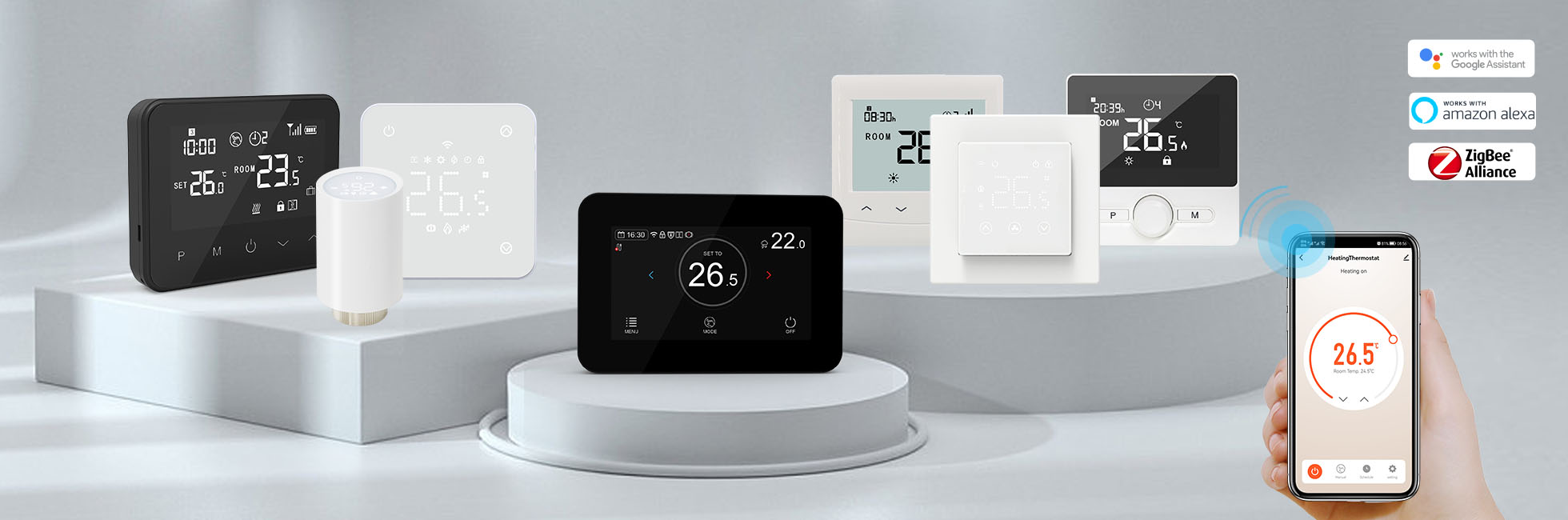
This 2-in-1 thermostat is designed to combine a underfloor heating thermostat and a fan coil thermostat. This combination offers precise temperature control for both heating and cooling in various settings. The unit allows users to effortlessly manage both systems from a single, intuitive interface, making it a more efficient and space-saving solution.


Underfloor Heating & Fan Coil Smart Thermostats


Key Features:


1.Dual System Control:

Underfloor Heating Control: Automatically adjusts the heating system to ensure even and consistent warmth across the floor, improving comfort and energy efficiency.

Fan Coil Unit Control: Adjusts the operation of fan coils to provide cooling or heating, ensuring a comfortable indoor temperature year-round.


2.Smart Technology Integration:

Wi-Fi or Bluetooth connectivity allows for remote access via mobile apps or smart home systems, providing users with the convenience of adjusting temperatures from anywhere.


3.Energy Efficiency:

Energy Saving Mode: Optimizes the performance of both underfloor heating and fan coil units to minimize energy consumption while maintaining comfort.

Programmable Schedules: Users can set heating and cooling schedules to align with your lifestyle, further reducing energy waste.


5.User-Friendly Interface:

Large LCD Display:displays temperature reading 、user settings and heating or cooling modes


6. Meet multiple needs:

Thermostat with14pcs wiring terminals: Compared to a maximum of 9 terminals, when there are not enough, only one I/O module can be added. Now increasing to 14 terminals not only saves costs, It can also simultaneously meet the needs of heating/cooling/ventilation/0-10V output/high, medium, and low 3 speed fans/external sensors/room cards/window cards/door cards, etc

What’s Advantage of Valve Type Selection and Delay Time Setting in Wiring Centre

When setting up the HR-02 wireless wiring centre for heat pump heating system, two critical parameters need attention: Valve Type Selection and Delay Time Setting. Proper configuration of these settings is essential for optimal system performance.

room heating control

1. Valve Type Selection

The actuator type can be configured to either Normally Open (NO) or Normally Closed (NC). The choice determines how the actuators respond when the heating system is activated.

Choosing the wrong valve type can lead to system malfunctions, such as the wiring centre failing to operate correctly. The HR-02 wiring centre allows for easy selection between NO and NC configurations, ensuring that users can adjust settings according to their specific needs without concern.


2. Delay Time Setting

The delay time setting for the pump and boiler can be adjusted between 0 to 6 minutes using a bridge jumper. This feature is crucial as it helps mitigate issues related to short cycling, where the pump and boiler frequently turn on and off in quick succession. Short cycling can lead to increased wear and tear on these components, potentially shortening their lifespan.


The proper delay time can ensure the pump and boiler have adequate time to stabilize before being activated again to protect the equipment and keep the room heating control without reducing unnecessary energy consumption.

Why Choose E-Top PTAC Thermostat

E-TOP PTAC Thermostats Are Ideal For every PTAC Units

E-TOP PTAC thermostats can control virtually every PTAC brand on the market, and give you the flexibility of installing a wireless energy saving thermostat anywhere in the room.


Why Choose E-Top PTAC Thermostat?

UNIVERSALLY COMPATIBLE

Works seamlessly with virtually every PTAC manufacturer in the market.The thermostats provide standard W/Y/G/OB terminals for every contacts.


WIRELESS INSTALLATION

Use existing wires in the wall, or install our wireless thermostat anywhere in the guestroom.

The communication distance can up to 120 meters in open air.


FAN SPEED CONTROL

Allow your guests to select between high and low fan speeds for maximum comfort.


EXTEND PTAC LIFE

By reducing PTAC runtimes in your guestrooms, you’ll save more energy out of your PTAC units, improving your overall longevity.


EASY INSTALLATION

E-TOP PTAC thermostat can be easily installed in under 10 minutes per room with the battery installation and the wireless receiver.

E - TOP PTAC Thermostat