Choosing between Radio Shuttle Racking and Drive-In Racking is a common decision for warehouses looking to increase pallet storage capacity without expanding their building footprint. Both systems reduce the number of forklift aisles and support high-density storage, but they differ in how pallets are handled, how inventory moves, and how warehouse operations are organized.
For warehouses storing large quantities of similar products, Drive-In Racking can be a practical and economical solution. Radio Shuttle Racking, on the other hand, uses a powered shuttle cart to move pallets inside storage lanes, reducing forklift travel within the rack structure and improving handling efficiency.
The right system depends on pallet volume, SKU distribution, inventory rotation requirements, picking frequency, labor costs, and the available warehouse space. This guide compares both systems to help warehouse managers, logistics operators, and business owners choose the right pallet storage solution.
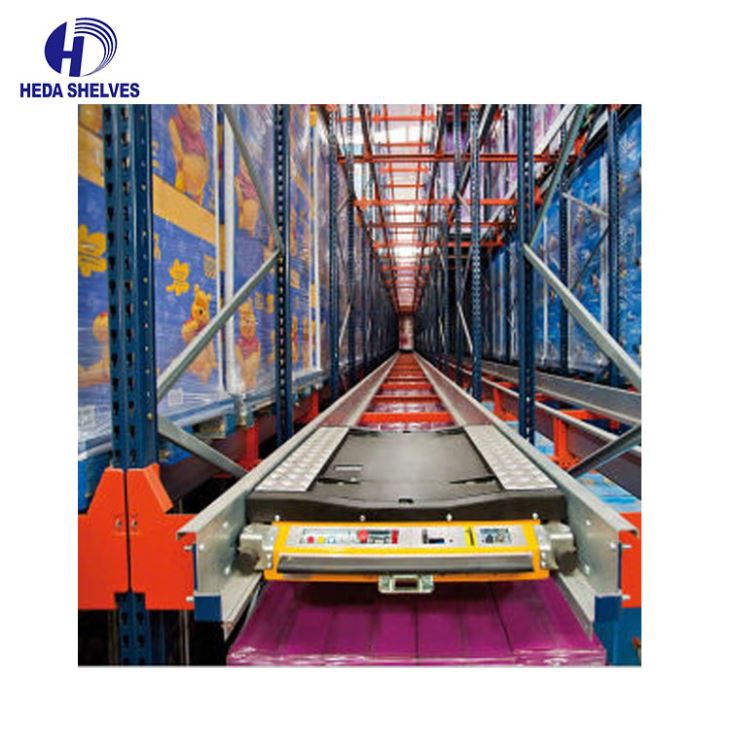
What Is Radio Shuttle Racking?
Radio Shuttle Racking is a semi-automated high-density pallet storage system consisting of rack structures, shuttle carts, rails, and forklifts. Instead of driving into storage lanes, forklift operators place pallets at the lane entrance. A battery-powered shuttle then transports the pallet to an available storage position.
During retrieval, the shuttle collects the pallet and brings it back to the loading or unloading position, where the forklift removes it. This reduces the need for forklifts to travel deep inside rack lanes and helps improve warehouse handling efficiency.
Radio Shuttle Racking is particularly suitable for warehouses handling large quantities of the same product, including food and beverage distribution, cold storage, FMCG, manufacturing, and seasonal inventory.
HEDA Shelves provides customized Radio Shuttle Racking Systems designed around pallet dimensions, load capacity, warehouse layout, storage depth, and operational requirements.
What Is Drive-In Racking?
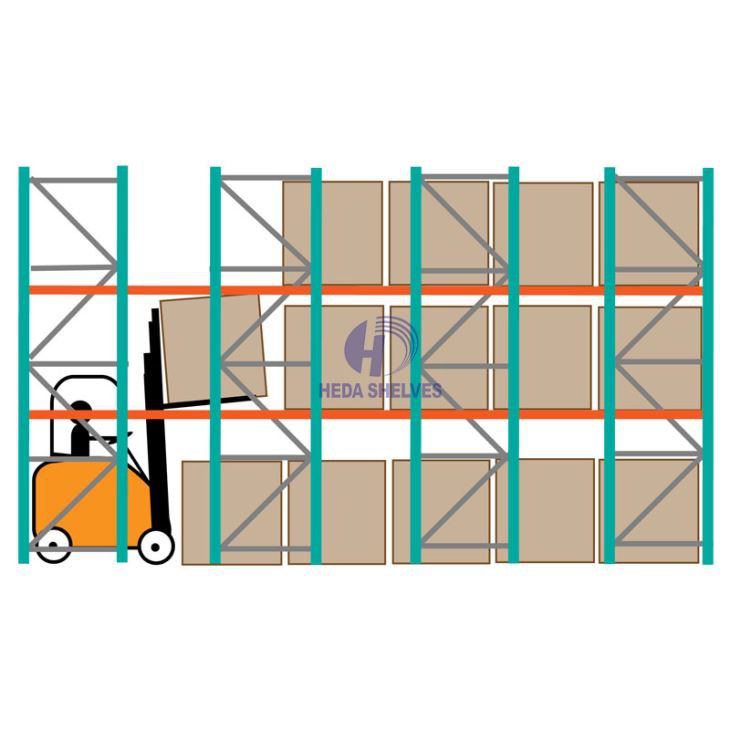
Drive-In Racking is a compact pallet storage system that allows forklifts to enter storage lanes directly. Pallets are supported by rails on both sides and stored one behind another, eliminating many conventional forklift aisles.
In a typical drive-in system, forklifts enter the lane to deposit or retrieve pallets. The system is commonly operated using the LIFO inventory principle, meaning the last pallet loaded is generally the first pallet retrieved. This makes it suitable for products that do not require strict chronological rotation.
Drive-In Racking is frequently used for bulk storage of homogeneous products, including raw materials, packaged goods, building materials, and seasonal stock.
For warehouses with a limited number of SKUs and high pallet quantities per SKU, Drive-In Storage Racking can help reduce aisle space and increase the number of pallet positions available within the same building.
Radio Shuttle vs Drive-In Racking: Key Differences
Although both systems are designed for dense pallet storage, the main difference is how pallets move through the storage lanes. Radio Shuttle Racking relies on a powered shuttle to transport pallets, while Drive-In Racking requires the forklift to enter the storage lane directly.
| Comparison Factor | Radio Shuttle Racking | Drive-In Racking |
|---|---|---|
| Pallet movement | Powered shuttle moves pallets inside lanes | Forklift enters the storage lane |
| Storage density | Very high density with fewer operating aisles | High density by eliminating conventional aisles |
| Inventory access | Access is organized by shuttle lanes | Access is limited by lane depth and pallet sequence |
| Inventory rotation | FIFO or LIFO can be configured depending on layout | Usually LIFO in drive-in configuration |
| Forklift operation | Forklift mainly operates at lane entrances | Forklift travels into rack lanes |
| Handling efficiency | Reduces forklift travel inside storage lanes | Depends on forklift maneuvering and lane depth |
| Investment | Higher initial investment due to shuttle equipment | Generally lower initial equipment investment |
| Best suited for | High-volume pallet storage and frequent handling | Bulk storage with fewer product varieties |
Which System Offers Better Warehouse Storage Density?
Both Radio Shuttle Racking and Drive-In Racking can significantly improve warehouse storage density compared with conventional selective pallet racking. Their compact layouts reduce the floor space occupied by forklift aisles and allow more pallet positions to be installed.
Drive-In Racking achieves density by creating deep storage lanes where pallets are placed sequentially. Radio Shuttle Racking achieves similar compact storage through deep lanes while using shuttle carts to move pallets inside the structure.
In warehouses with very deep lanes, frequent pallet movement, or high forklift activity, Radio Shuttle Racking may offer operational advantages because forklifts do not need to enter the storage structure for every pallet movement.
However, the actual storage capacity depends on warehouse dimensions, clear height, pallet sizes, aisle widths, fire protection requirements, structural design, and the number of storage lanes. A layout calculation is necessary before comparing storage capacity using percentages.
FIFO and LIFO: Which Inventory Flow Do You Need?
Inventory rotation is one of the most important factors when selecting a pallet racking system.
FIFO (First-In, First-Out) means the first pallet stored is the first pallet retrieved. This method is often preferred for products with expiration dates, batch management requirements, or a need for chronological stock rotation.
LIFO (Last-In, First-Out) means the most recently stored pallet is retrieved first. This approach is suitable for products with longer shelf lives, uniform inventory, or stock that does not require strict rotation.
Drive-In Racking normally follows LIFO because loading and unloading take place from the same side. A drive-through layout with access from both ends can support FIFO operations, although the warehouse layout and operating process must be designed accordingly.
Radio Shuttle Racking can be designed for FIFO or LIFO inventory flow. FIFO configurations typically use loading and unloading sides separately, while LIFO configurations allow pallets to be loaded and retrieved from the same side.
For food, beverage, pharmaceutical, and temperature-controlled inventory, the required stock rotation method should be established before the racking layout is finalized.
Which Racking System Is Better for Cold Storage?
Cold storage facilities often have high operating costs because refrigeration consumes significant energy. Increasing pallet density can help reduce the volume of warehouse space that needs to be cooled per pallet stored.
Radio Shuttle Racking is frequently considered for freezer and refrigerated warehouses because it supports deep storage lanes, reduces forklift travel inside the rack structure, and can be configured for temperature-controlled applications.
Drive-In Racking is also suitable for cold storage, especially where inventory consists of large quantities of similar products with relatively low picking frequency.
When choosing a system for cold storage, warehouse operators should also evaluate shuttle battery performance, equipment maintenance access, temperature compatibility, pallet quality, frost conditions, fire protection, and the required stock rotation method.
The most suitable solution is not necessarily the system with the highest theoretical storage density. It should also maintain reliable throughput, safe handling, and manageable operating costs throughout the warehouse's service life.
Cost Comparison: Initial Investment and Long-Term Efficiency
Drive-In Racking generally requires a lower initial investment because it uses a conventional rack structure without powered shuttle carts. For warehouses with limited handling frequency and stable inventory, it can provide an economical high-density storage solution.
Radio Shuttle Racking requires additional investment in shuttle equipment, batteries, controls, charging arrangements, and maintenance. However, the investment may be justified when pallet movements are frequent, forklift travel is time-consuming, labor costs are high, or warehouse throughput needs to improve.
Rather than comparing only the purchase price, warehouse managers should evaluate total cost of ownership, including:
- Initial rack structure and shuttle equipment investment
- Forklift requirements and labor costs
- Pallet handling time and daily throughput
- Maintenance, battery replacement, and equipment downtime
- Warehouse space utilization and potential expansion costs
- Inventory management and product damage risks
A warehouse with high pallet turnover may benefit more from shuttle automation, while a warehouse focused primarily on bulk storage may achieve a better return from Drive-In Racking.
When Should You Choose Radio Shuttle Racking?
Radio Shuttle Racking is a strong choice when your warehouse needs high storage density without sacrificing handling efficiency. It is particularly suitable for businesses with large pallet quantities per SKU, frequent storage and retrieval operations, or warehouse environments where forklift travel needs to be minimized.
Typical applications include:
- Cold storage and freezer warehouses
- Food and beverage distribution
- FMCG and seasonal product storage
- Manufacturing raw material warehouses
- Distribution centers with high pallet throughput
If your operation is planning to improve warehouse automation gradually, shuttle systems can also provide a practical transition between conventional forklift storage and more advanced automated warehouse solutions.
When Should You Choose Drive-In Racking?
Drive-In Racking is often the better option for warehouses with a limited number of SKUs, large quantities of pallets per product, and relatively predictable storage and retrieval patterns.
It works well for bulk inventory where individual pallet access is less important than maximizing available storage space. The straightforward structure can also make it easier for businesses to control equipment investment while improving warehouse capacity.
Typical applications include:
- Bulk storage of identical products
- Seasonal inventory and reserve stock
- Manufacturing materials and components
- Warehouses with low picking frequency
- Facilities prioritizing storage density over direct pallet access
For businesses that need high-density storage but do not require shuttle-assisted pallet movement, Drive-In Racking can provide a balance between capacity and investment.
How to Select the Right Pallet Racking System for Your Warehouse
Before making a final decision, warehouse managers should evaluate the following operational details:
- SKU quantity: How many product types are stored, and how many pallets are available per SKU?
- Pallet dimensions: Are pallet sizes and loads consistent across storage lanes?
- Inventory rotation: Does your operation require FIFO, LIFO, or batch-based retrieval?
- Daily throughput: How many pallets are stored and retrieved during a typical shift?
- Warehouse layout: What are the available building dimensions, ceiling height, and floor conditions?
- Equipment availability: Do you have forklifts, trained operators, and maintenance resources?
- Future growth: Will pallet volume, product range, or handling requirements change over the next few years?
A customized warehouse layout should consider these factors together rather than choosing a racking system based on price or storage density alone.
HEDA Shelves offers customized warehouse storage solutions for different pallet sizes, load requirements, operating environments, and warehouse layouts. Its engineering team can help compare Radio Shuttle Racking and Drive-In Racking based on your actual storage and handling requirements.
To discuss your warehouse project, visit HEDA Shelves and request a layout proposal based on your pallet specifications, warehouse dimensions, and daily operation needs.
Frequently Asked Questions
Is Radio Shuttle Racking better than Drive-In Racking?
Radio Shuttle Racking is generally better for warehouses that require frequent pallet movement, reduced forklift travel inside storage lanes, and higher handling efficiency. Drive-In Racking is often more cost-effective for bulk storage with fewer SKUs and lower picking frequency. The better option depends on warehouse throughput, inventory rotation, and budget.
Which racking system has higher storage density?
Both Radio Shuttle Racking and Drive-In Racking provide high-density pallet storage by reducing forklift aisles. Actual pallet capacity depends on lane depth, rack height, pallet dimensions, aisle layout, building constraints, and safety requirements. Radio Shuttle Racking may offer additional layout and operational advantages in deep-lane storage applications.
Can Radio Shuttle Racking support FIFO inventory management?
Yes. Radio Shuttle Racking can be designed for FIFO or LIFO inventory flow. FIFO layouts typically use separate loading and unloading sides, while LIFO configurations use the same side for pallet loading and retrieval.
Is Drive-In Racking suitable for cold storage?
Yes. Drive-In Racking is widely considered for cold storage warehouses that handle large quantities of similar products. Radio Shuttle Racking is another suitable option when operators need to improve pallet handling efficiency and reduce forklift movement in refrigerated or freezer environments.
Does Radio Shuttle Racking require special forklifts?
Radio Shuttle Racking does not necessarily require a specialized forklift for every storage movement. Forklifts are generally used to place pallets at the shuttle loading position and transfer shuttle carts between lanes where required. The forklift type and operating arrangement should be confirmed during system design.
How do I calculate the ROI of Radio Shuttle Racking?
ROI should be evaluated by comparing the initial investment with savings from labor, forklift travel, pallet handling time, warehouse space, and operational efficiency. The calculation should also include shuttle maintenance, battery replacement, equipment downtime, and the expected annual pallet throughput.