When sourcing wooden chicken coops from China, B2B buyers often face a fundamental decision: should they purchase an existing design with their own branding, or develop a product around their own specifications? The answer affects more than appearance. It determines how much design work the buyer must provide, who pays for development, how product changes are approved, and what happens when the business wants to scale.
OEM and ODM are frequently used interchangeably in supplier discussions, but they can describe different working arrangements. Understanding those differences helps importers, garden retailers, pet supply brands, and e-commerce sellers choose a sourcing model that fits their budgets, timelines, and product strategy.
Quick Answer
OEM is generally the better fit when a buyer has a defined product design or specification that a manufacturer will produce. ODM is generally more suitable when the manufacturer provides an existing design or develops a product concept that the buyer can adapt and sell under an agreed arrangement.
An OEM chicken coop manufacturer should be able to explain how it converts the buyer's drawings, specifications, and approved samples into repeatable production. An ODM chicken coop supplier should clarify which designs are already available, what can be changed, and whether design ownership or exclusivity is included in the agreement.
Key Takeaways
- OEM typically offers greater buyer control over product specifications, while ODM can reduce design-development work.
- Both models can support private labeling, depending on the supplier's capabilities and contract terms.
- Logo printing alone does not necessarily mean a product is exclusive to one buyer.
- Confirm ownership of drawings, molds, tooling, and customized components before paying development fees.
- Compare development cost, MOQ, lead time, product differentiation, and repeat-order flexibility together.
What Is OEM Manufacturing for Chicken Coops?
OEM, or original equipment manufacturing, generally describes a production arrangement in which the buyer supplies the product design, technical specifications, or defined requirements and the manufacturer produces the goods accordingly. The exact division of responsibilities depends on the contract.
For wooden chicken coops, the buyer might provide drawings covering overall dimensions, timber sections, roof design, mesh openings, door placement, nesting boxes, hardware, surface finish, and carton layout. The factory then reviews whether the design can be manufactured efficiently and identifies any technical issues before production.
This approach is useful when a brand already understands its target market and wants a distinctive product. A retailer may need a specific footprint to fit its product range, while an e-commerce brand may require a flat-pack design that meets a target carton size or shipping-cost limit.
However, the buyer must provide enough detail to prevent misunderstandings. A drawing that specifies the outside dimensions but leaves timber thickness, fasteners, coating, or assembly tolerances undefined can still produce inconsistent results.
What Is ODM Manufacturing for Chicken Coops?
ODM, or original design manufacturing, generally means that the supplier offers an existing design or provides product-development support based on the buyer's requirements. Instead of creating every detail from scratch, the buyer starts with a design that the manufacturer already understands or can adapt.
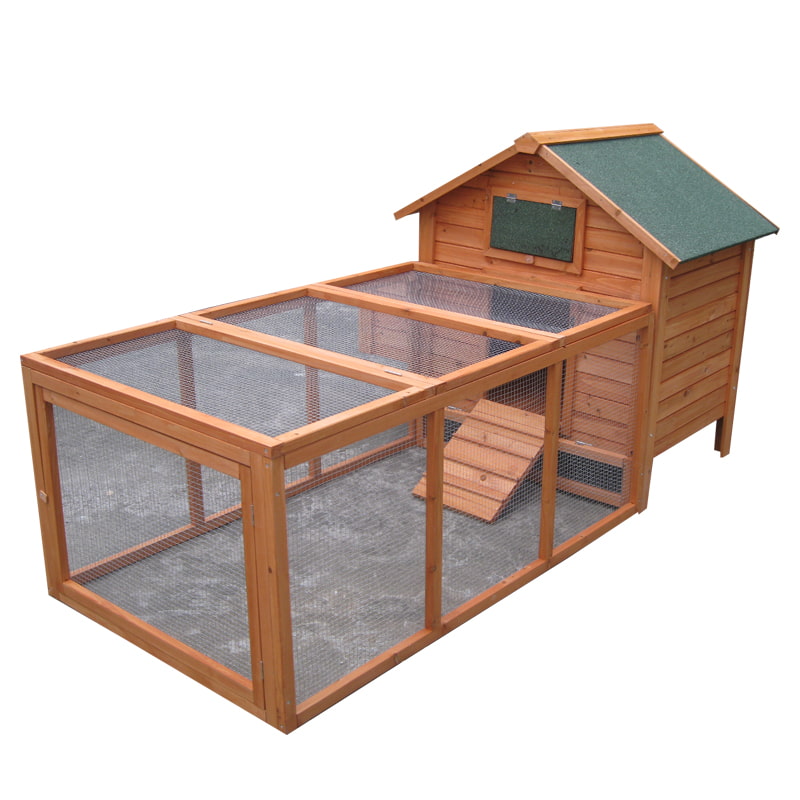
For example, a buyer may select a wooden coop with an attached run and ask for a different color, an added logo, modified packaging, or a revised accessory set. The supplier can explain which changes are straightforward and which would require new tooling, structural changes, or additional testing.
ODM can shorten the development process, particularly for businesses entering the chicken coop category for the first time. It may also make it easier to compare established product configurations before committing to a custom design. However, the buyer should not assume that an existing model is exclusive or that every requested modification is included in the standard price.
OEM vs ODM: The Main Differences
| Factor | OEM model | ODM model |
|---|---|---|
| Starting point | Buyer-defined design or specification | Supplier's existing design or development proposal |
| Design workload | Usually higher for the buyer | Usually lower when an existing model is suitable |
| Customization | Can be extensive if technically feasible | Depends on the available design and agreed modifications |
| Development cost | May include engineering, prototypes, and tooling | May be lower for existing designs; custom changes can add cost |
| Time to market | Depends on design readiness and validation | Can be shorter when the existing model requires few changes |
| Product differentiation | Potentially greater with a distinctive specification | May be limited if multiple buyers use the same base design |
| Design ownership | Must be defined in the agreement | Existing design ownership often remains with the supplier unless otherwise agreed |
| Best suited to | Established brands with defined product requirements | Businesses seeking a faster route to market |
These are general commercial distinctions rather than fixed legal definitions. Suppliers use the terms differently, so the actual scope of work and ownership rights should always be written into the contract.
Which Model Is Better for Your Business?
Choose OEM When Product Specifications Matter Most
OEM may be the stronger option when your business has a defined product concept, proprietary drawings, or specific functional requirements. For example, you may want a coop designed around a particular retail footprint, a revised nesting-box layout, a specific run configuration, or a packaging format optimized for your distribution network.
Before production, provide a complete specification and request a manufacturability review. Clarify which details the factory can reproduce, which require redesign, and which need physical validation. Also confirm whether the buyer or manufacturer owns new drawings, molds, jigs, and other development assets.
Choose ODM When Speed and Lower Development Workload Matter
ODM is often attractive for distributors or online sellers that need to enter a category without developing a completely new design. Starting from an existing coop can simplify sampling, reduce design work, and help the buyer evaluate the product before investing in major changes.
The trade-off is differentiation. A standard model may be available to other buyers, so changing the logo or carton artwork alone may not create a distinctive product. Ask whether the supplier can offer exclusive dimensions, a different configuration, unique accessories, or another meaningful modification if exclusivity matters to your strategy.
Private Label Is Not the Same as OEM or ODM
Private labeling describes how a product is branded and marketed, rather than necessarily describing how it was designed. A retailer can sell a supplier's existing coop under its own brand, provided the branding arrangement and applicable rights are agreed.
A private label chicken coop may therefore use an existing ODM design, an OEM product specification, or a customized combination of the two. Branding can include a logo on the product, branded cartons, assembly instructions, labels, or other agreed materials.
Before approving private-label production, clarify which branding elements are included in the quotation, whether there are additional setup fees, and who approves artwork. Confirm that the supplier has the right to use any designs, images, or brand assets supplied by the buyer.
Most importantly, distinguish brand exclusivity from product exclusivity. A factory may agree not to use your logo for other customers without agreeing to stop selling the same underlying coop design to other buyers. If you need market or design exclusivity, specify the protected design, territory, duration, channels, and contractual conditions.
What Can Be Customized on a Wooden Chicken Coop?
Customization can range from a simple logo to a substantial product redesign. The more components that change, the more important it becomes to confirm dimensions, compatibility, inspection requirements, and development costs.
| Customization area | Examples | Questions to ask |
|---|---|---|
| Branding | Logo, labels, carton graphics, instruction manuals | Are artwork setup and printing included? |
| Appearance | Color, finish, roof style, decorative details | How is color consistency approved? |
| Structure | Dimensions, run layout, door position, nesting boxes | Are new drawings, prototypes, or tooling needed? |
| Accessories | Ramps, trays, perches, feeders, or hardware sets | Do changes affect assembly or component compatibility? |
| Packaging | Carton size, inserts, parts labeling, manuals | Will the new configuration change shipping dimensions? |
For businesses comparing existing designs, the supplier's wooden chicken coop range provides a starting point for evaluating available structures. Buyers should request model-specific specifications before deciding whether to purchase an existing configuration or commission further changes.
How to Compare OEM and ODM Costs
OEM is not always more expensive, and ODM is not automatically cheaper. The cost depends on how much development work is required, whether existing tooling can be used, the number of components, the order quantity, and the extent of customization.
When comparing proposals, separate the following cost elements:
- Development: drawings, engineering, prototypes, and sample revisions.
- Tooling: molds, fixtures, jigs, or dedicated production equipment where applicable.
- Production: timber, hardware, coatings, assembly, and quality inspection.
- Branding: logos, labels, printed cartons, and customized manuals.
- Logistics: carton dimensions, freight, insurance, import duties, and destination handling.
- Risk allowance: inspection, potential rework, spare parts, and the handling of defective units.
A useful comparison is the total cost of delivering accepted products, not simply the factory's quoted unit price. For a new design, also consider whether development costs can be spread over forecast order volumes and whether future modifications will incur additional charges.
Questions to Ask Before Signing an OEM or ODM Agreement
- Is the product based on an existing supplier design or a buyer-owned specification?
- Which changes are included in the quoted price, and which require additional development fees?
- Who owns the drawings, tooling, prototypes, and customized design elements?
- Can the supplier sell the same or a similar design to other customers?
- What is the MOQ for the standard model, and does customization change the MOQ?
- How many sample revisions are included, and what triggers a new charge?
- What specifications and approved samples will be used for production inspection?
- How are changes to materials, hardware, or manufacturing processes approved?
- What are the lead times for sampling, production, inspection, and dispatch?
- What remedies apply if the delivered products fail the agreed requirements?
Practical Example: Launching a Private-Label Coop Range
Consider a distributor planning to launch three wooden chicken coop models under its own brand. The first model is intended to be an affordable entry-level option, the second includes a larger attached run, and the third targets customers seeking a more distinctive design.
For the first two models, an ODM approach may be practical if suitable existing designs are available. The buyer can compare dimensions, construction, packaging, and available accessories before selecting models for private labeling. For the third model, OEM may be more appropriate if the business needs a unique structure or a specific combination of features.
The buyer should request samples, confirm all customization costs, approve branding artwork, and define whether any design exclusivity applies. If the three models share components, the buyer can also ask whether common hardware or packaging elements can simplify inventory management without compromising product quality.
This hybrid approach can help a business balance speed, differentiation, and investment. The right choice is not necessarily to use one model for every product; it is to assign the appropriate development method to each SKU.
Frequently Asked Questions
What is the difference between OEM and ODM chicken coops?
OEM generally involves manufacturing to a buyer-defined design or specification. ODM generally starts from a supplier's existing design or development capability. Actual responsibilities and ownership depend on the agreement.
Can I sell ODM chicken coops under my own brand?
Often, yes, if the supplier supports private labeling and the parties agree on branding rights. Confirm whether the same underlying design can be sold to other buyers and whether any exclusivity is included.
How do I choose an OEM chicken coop manufacturer?
Look for a supplier that can interpret your drawings, explain manufacturing constraints, control materials and assembly, provide representative samples, and follow documented specifications during mass production.
What should I look for in an ODM chicken coop supplier?
Check the available designs, customization limits, sample quality, production consistency, MOQ, lead time, and ownership terms. Ask for a clear list of which modifications are included in the quotation.
Does private labeling require a custom mold?
Not necessarily. Branding an existing model may require only agreed labels, logos, packaging, or instructions. Structural changes may require additional tooling or development, depending on the design.
Can I request exclusive rights to a custom chicken coop design?
You can negotiate exclusivity, but it should be documented rather than assumed. Define the protected design, applicable markets, duration, permitted sales channels, and any exceptions in the agreement.
OEM and ODM offer different routes to building a competitive chicken coop range. OEM is useful when product specifications and differentiation are central to the business, while ODM can help buyers enter the market with less initial design work. Private labeling can work with either model, provided branding, design ownership, customization costs, and exclusivity are clearly defined before production.