It's common to generate noise when air conditioners are operating. However, continuous humming, whistling fan sounds, or ratting noises from pipes can not only affect rest at homes but also influence customers' experience in offices, hotels, shops, and such commercial scenarios. Basically, the noises are from compressor vibration, fan noise, piping resonance, and unstable installation. To reduce the noise generation, we can adjust in four aspects: initial installation, component modification, routine maintenance, and equipment selection.
I. Confirm the source of the noise.
From the compressor vibration: The compressor will generate vibration continuously during operation. Lack of vibration-dampening measures: the vibration will transfer to brackets and walls, forming a low-frequency hum. That's the major source of the noise from the outdoor unit.
Fan motor noise: The fan motors in both indoor and outdoor units can generate noise under high-speed rotation. Occasions like clogged filters, dust accumulation or deformation on fan blades, and worn bearings will all enlarge the whistling sounds. And the higher the fan speed is, the louder the noise will be.
Piping resonance and rattling: If the refrigerant pipes contact metal brackets or walls directly, then the air conditioner outdoor unit with vibration will knock with the pipes, resulting in an intermittent "clacking" or rattling sound.
Unstable installation: Loose bracket screws or unbalanced placement of the machines will lead to shaking during operation. This amplifies vibrations and leads to a significant increase in noise levels.
II. Practices to reduce noise
1. Outdoor Unit Vibration Dampening: Eliminating Low-Frequency Humming
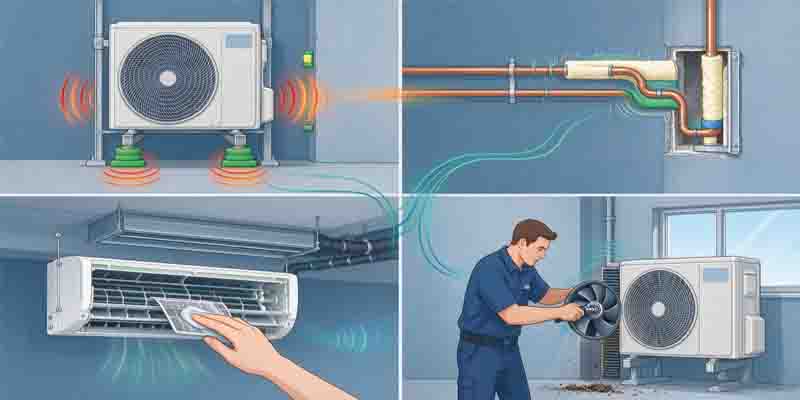
Add rubber vibration-dampening pads at the base of the outdoor unit to isolate vibrations from the compressor to the ground and the brackets.
Tighten the bracket screws and add vibration-dampening pads between the bracket and the wall.
The outdoor unit should be placed horizontally. Tilting the position will exaggerate the vibration from the compressor and make louder noise.
2. Piping optimization: eliminating resonance and knocking sounds
Wrap copper pipes with insulation foam or vibration-dampening rubbers at the positions that the copper pipe connects with walls and brackets, avoiding direct metal-on-metal contact.
Keep reasonable loops for vibration-dampening between copper pipes. This would reduce the resonance.
3. Noise reduction for indoor unit
Clean the filters and evaporators regularly. Dirty and clogged filters will obstruct airflow, increasing the load for the fan motor and the noise.
Set low and medium wind speeds in daily lives. High-level wind speed will noticeably increase the noise.
Check if the indoor bracket is loose. For ceiling ducted air conditioners, reinforce the mounting screws and use flexible duct connections to reduce the noise generated by vibration.
4. Routine maintenance: Preventing noise escalation
Check if the fan bearing is worn. Harsh friction sounds symbolize the bearing is worn and needs to be lubricated or replaced timely.
Blocks lodged in the fan can lead to abnormal sounds, so cleaning the outdoor unit fins is necessary.
Leave enough space between the outdoor unit and the wall or window; do not place it close to the wall. Small spaces will reflect sounds, making them louder and louder.
The reduction of air conditioning noise does not mean to modify the air conditioner overwhelmingly. Most of the noise issues are caused by installation and maintenance. Implementing vibration-dampening measures and cleaning the machines regularly can lower the operating noise effectively as well as reduce component wear and extend its lifespan. If the sounds are unusual, please fix it timely and ensure the machines operate stably and quietly.