Configuring a commercial 3H/2C heat pump requires accurate O/B reversing valve staging and intelligent auxiliary heat lockout thresholds, while LoRaWAN Class C provides the zero-latency communication link needed for centralized BMS supervisory control. In commercial multi-family and hospitality properties across North America, multi-stage heat pumps offer exceptional seasonal efficiency. However, when thermostats lack proper staging logic, high-draw electric resistance elements fire prematurely, causing major spikes in utility peak demand charges.
To achieve optimal staging efficiency, facility integrators must deploy a reliable lorawan heat pump thermostat capable of handling complex multi-stage terminal logic without sacrificing sub-GHz communication stability.
Understanding 3H/2C Heat Pump Staging
Commercial multi-family units rely heavily on 3-Stage Heating / 2-Stage Cooling (3H/2C) configurations to balance electrical demand and mechanical longevity. Instead of cycling a large compressor at full capacity, two-stage compressor systems handle the base load on low stage (Y1) and modulate to high stage (Y2) only during peak thermal deltas.
The third heating stage typically consists of electric resistance strip heat (W/AUX). While essential when outdoor ambient conditions drop below the heat pump balance point, improper thermostat staging logic often engages auxiliary heat simply to satisfy small setpoint adjustments, wasting significant kilowatt-hours.
Terminal Wiring Standards for Multi-Stage Units
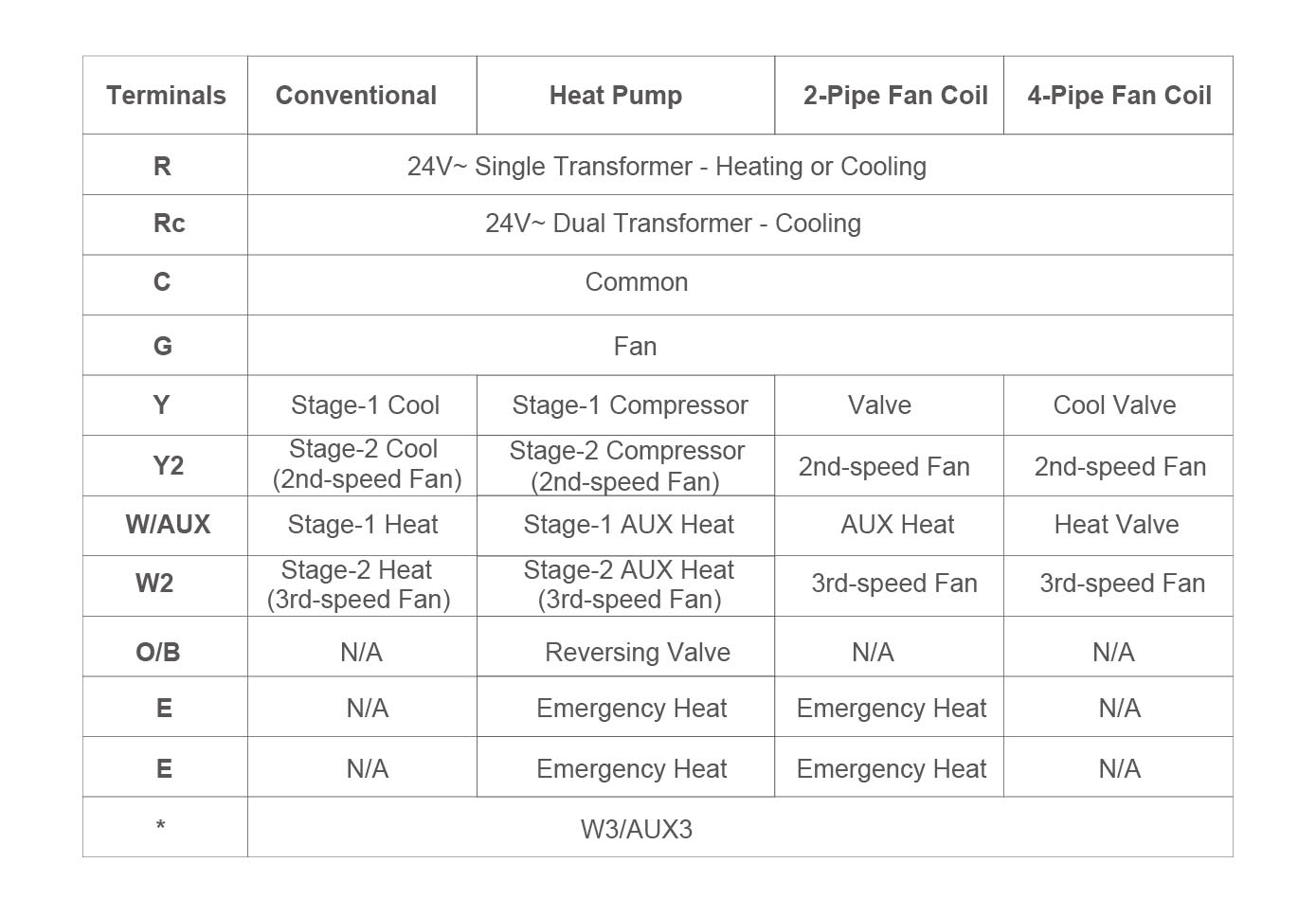
Proper field installation requires exact pinout mapping at the thermostat subbase to protect low-voltage control transformers:
- RC and RH (24VAC Line): Tied via an internal jumper on single-transformer setups to power the logic board and switching relays.
- Y1 and Y2 (Compressor Stages): Y1 energizes Stage-1 compressor operation; Y2 calls Stage-2 capacity expansion.
- O/B (Reversing Valve): Dictates refrigerant flow direction for cooling or heating cycles.
- W/AUX and E (Supplemental Heat): W/AUX brings on electric bank strips alongside compressor runs; E isolates the outdoor unit completely during mechanical failure.
O/B Reversing Valve Logic: Heating vs. Cooling
Reversing valve misconfiguration represents one of the most frequent technician callbacks during commissioning. Equipment manufacturers differ fundamentally in their default valve states: Rheem and Ruud units typically energize the B terminal during heating, whereas Carrier, Trane, and Lennox energize the O terminal during cooling. Commercial controllers must provide menu-level reversing valve selection to ensure proper seasonal operation without requiring field rewiring.
Smarter Auxiliary Heat Management Algorithms
Basic mechanical and consumer thermostats use simple differential thresholds. A sudden 3°F setpoint shift causes them to fire Y1, Y2, and auxiliary electric heat simultaneously. In contrast, commercial-grade LoRaWAN thermostats utilize Proportional-Integral (PI) algorithms that monitor thermal rate-of-recovery. The controller holds auxiliary heat in lockout mode, giving the high-efficiency compressor stages adequate cycle time to satisfy room demand before introducing supplemental resistance banks.

Using LoRaWAN Class C for Responsive HVAC Control
Integrating multi-stage heat pumps into building management architectures requires reliable downlink latency. Powered continuously via the 24VAC C-wire, a Class C LoRaWAN node maintains continuously open receive windows. Unlike battery-powered sensors that queue commands until periodic wake-ups, Class C nodes allow supervisory BMS platforms to push immediate setpoint adjustments, load-shedding policies, and auxiliary heat lockout thresholds across building portfolios instantly.
Engineering-Grade IoT Hardware from E-TOP Controls
E-TOP Controls designs and manufactures commercial HVAC control hardware built specifically for systems integrators and OEM brands. Operating under strict ISO 9001:2015 quality standards, our engineering team provides customized payload definitions, selectable O/B staging logic, and robust sub-GHz radios. Explore our technical documentation in the Commercial HVAC Control Knowledge Centre or contact our team to discuss custom engineering requirements for your next deployment.
Request OEM Spec Sheets & Pricing
📖 Technical Guides & Application Knowledge
Explore our detailed engineering articles to learn more about deploying the CH7600 in commercial environments: